
KELP FOREST COLLAPSE
Intertidal Foraging
THE IMBALANCE
Due to predator die-off, the Purple sea urchin population has exploded. They've decimated nearly 95% of our vital bull kelp forests replacing them with urchin barrens, causing these unwitting creatures to become the pariahs of the ecosystem.


THE PROBLEM IN CONTEXT
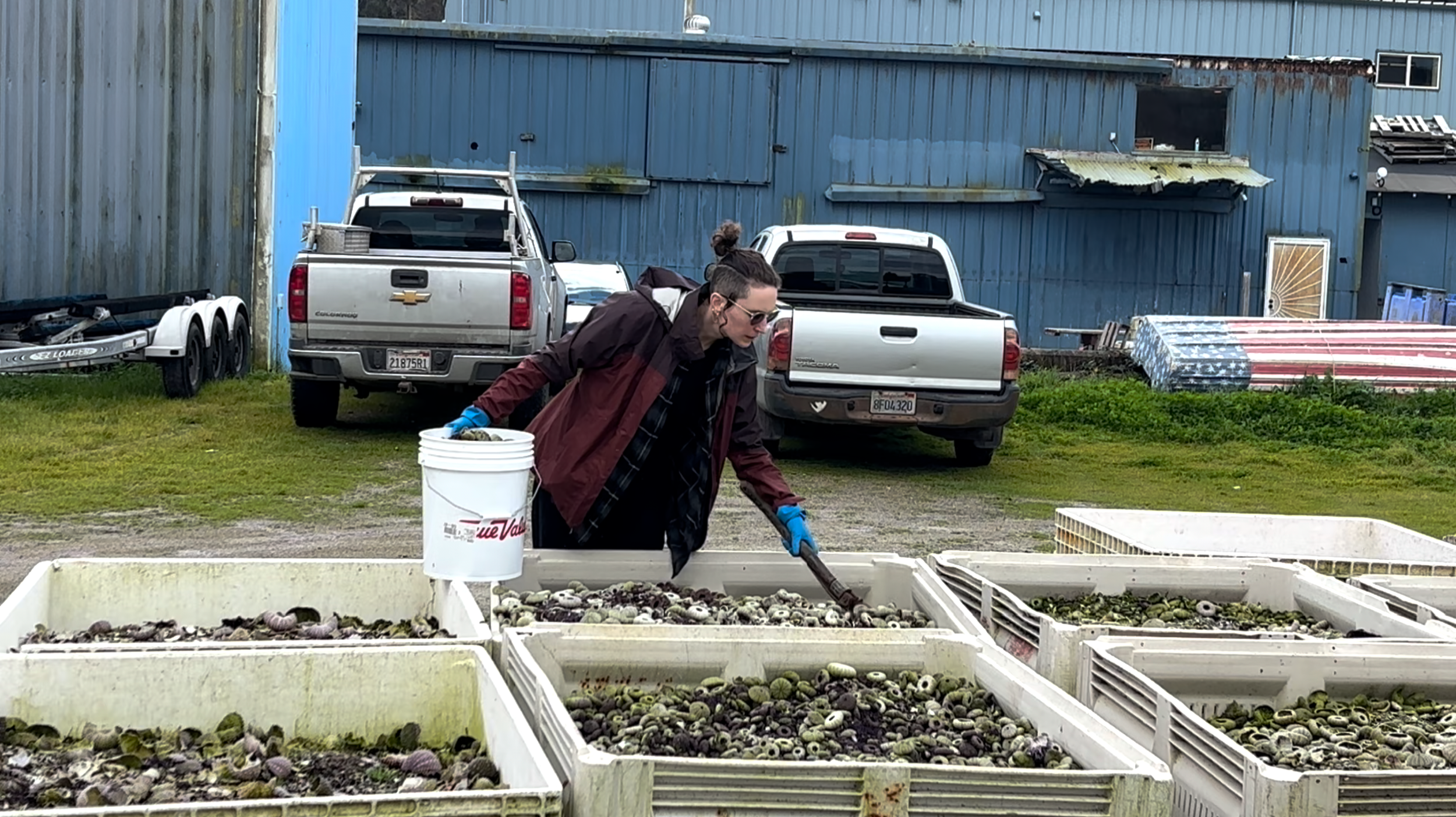
The Nature Conservancy, in their work on kelp forest restoration, have pulled millions of sea urchins out of the ocean off the coast of Fort Bragg. Ones larger than about 50mm, they rehabilitate and sell for their uni, a delicacy at sushi restaurants. The rest rot in the sun in giant plastic tubs. They’ve got more tests (the urchin’s shell) than they know what to do with. They have various local partners, but their supply far outweighs the demand so they’re eager to partner with design students like myself. After coordinating with Grant Downie, a second generation urchin diver, I made the drive up the coast on a beautiful February day. I came home with five gallon buckets of urchin tests and got to work turning them into a usable biomaterial.


THE INTERVENTION
Gloves armored in urchin bio-crete protect hands from their spines when reaching into tide pools. Another tool helps crack open their shells to reveal the delicate flesh inside.
I invite the user to remake their connection to urchins through cultivating the practice of foraging. By adopting it as a food source, purple urchins are reframed from pest to nourishment, perhaps the most intimate interspecies relationship to be had.
Through foraging, we can help reduce urchin overpopulation while developing greater appreciation for the remarkable creatures that they are.
PROTOTYPING AND ITERATION


Mold-making proved to be the biggest challenge, but through exhaustive iteration, I landed on a final form that was able to return the complex shapes needed for tool design.
Urchin tests are composed almost entirely of high-magnesium calcium carbonate, which serves as an excellent starting point for biomaterial development. After experimenting with a couple of different formulations, I settled on a gelatin-based bio-resin that became incredibly hard and stoney with the addition of 125g of powdered urchin tests.
HOW IT WORKS
I designed both tools to take advantage of the innate properties of the bio-crete. The material shrinks and curls as it dries. The shrinkage allowed me to design more complex shapes without worrying too much about undercuts. The material would pull away from the mold on its own, creating room to then wiggle out. Curling was a useful property. I could pour the armor pieces flat (a much easier casting process) and then they would dry in shapes that naturally conformed to one's hands. The spear tips of the cracker were also modeled straight with the intention of drying into the gentle arc of their final form.

CURRENT STATUS AND REFLECTIONS